Is All-on-4 Considered an Invasive Surgery?
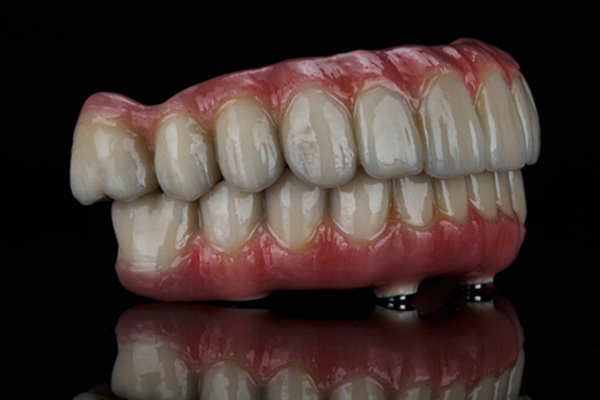
All-on-4 surgery replaces all the teeth in a dental arch with fixed dentures. The dentures are held in place by four implants in the jaw. If the person is missing all their teeth, they will need to have four implants in each jaw.
Getting a single dental implant is a process that requires one or more oral surgeries. Given that All-on-4 surgery requires the placement of at least four dental implants, does it qualify as an invasive surgery?
To answer this question, we have to learn the step-by-step process of All-on-4 surgery.
About All-on-4 fixed dentures
The most important part of All-on-4 fixed dentures is the dental implants that keep the false teeth in place. These implants are placed in the jaw, where they gradually fuse with the bone.
Once the implants are firmly buried in bone, a dentist adds connectors to them. These connectors or abutments connect the implants to the dentures.
All-on-4 surgery, step by step
The first thing a dentist or oral surgeon will do is screen their patient to find out if they are a good candidate for All-on-4 dentures. If the patient qualifies, then the dentist will:
- Perform medical imaging to provide useful information that will help to create a surgery plan
- Perform bone graft surgery if the patient lacks enough bone mass to anchor the implants. When placing All-on-4 dentures, oral surgeons prefer to avoid bone grafts surgery at all costs
- Once the patient heals, the doctor will take an impression or picture of the patient’s mouth. This will be step two for a patient that does not need a bone graft
- The dentist will use the impression and the patient’s input to design customized dentures. They will send the designs to a dental lab for fabrication
- The dentist will remove any remaining teeth and open the gums, exposing the jaw. They will drill a tiny hole into the jaw and place a dental implant into the hole. Finally, they will suture the gum shut
- The dentist will repeat step 5 three more times for the upper jaw and four more times for the lower jaw
- They will give the patient a set of temporary dentures to wear after the gums heal but before the implants fuse with the jaws
- After a few months, the patient will return to have the abutments attached to the implants. This procedure involves opening the gums to expose the implants and suturing them around the abutments
- It only takes a few weeks for the gums to heal. Once they do, the dentist will attach the dentures to the abutments
The whole process takes several months and several dentist visits, including at least one surgery. If the dentist combines certain steps, like the placement of the implant and the abutment, the process can go a whole lot faster. But this option is not for everybody.
How invasive is All-on-4 surgery?
It is a lot more invasive than getting one or two implant-supported crowns. The will have to sit through the placement of at least four implants, which takes longer. That said, all the steps in All-on-4 surgery are done on an outpatient basis, so they are not that invasive.
All a patient needs to do is take excellent care of their mouth after each procedure, and the whole process will go smoothly. You will have our experienced and skilled dentist to guide you through each step of All-on-4 surgery. Contact us to find out how you can get started.
Here's what you need…
Request an appointment here: https://middletown.premierdentalnewjersey.com or call Premier Dental of Middletown at (848) 351-8059 for an appointment in our Middletown Township office.
Check out what others are saying about our dental services on Yelp: All-on-4 Dental Implants in Middletown Township, NJ.
Related Posts
Those missing one or more molars may benefit from dental implants. The molars are the large, flat teeth in the back of your mouth, used to grind your food when chewing. Not counting your wisdom teeth, you have eight molars in your mouth, all of which play an important part in your ability to chew…
Dental professionals recommend a denture reline at least every two years. However, you might need to get your dentures relined more often depending on various factors, such as the materials used for the reline and the degree of bone loss you have experienced. You need to visit a general dentist once a year to get…
Dental fillings are commonly used in dentistry, but what else can these fillings be used for? There are quite a few uses that may surprise you! Here are just some of the many ways dental fillings can help improve your life and improve your smile. You’ll also learn about the best way to take care…
General dentistry is the branch of dentistry that focuses on oral health. Dentists are experts at identifying problems in your mouth or teeth and then fixing them. You might not realize it, but the food you eat can significantly impact your dental health over time. This article will cover how diet affects oral health and…